Armies do not move borders in Global Protocol: peace deals do. Taking a province in war makes it occupied, which gives you its output, raises your war score and lets you demand it. It becomes yours only when a peace deal says so. How much of a country one war can take, and what each province costs, depends on its size and on how long you have held it.
Where to find it
- On the map. The province tooltip shows OCCUPIED BY, UNDER SIEGE BY, RESISTANCE and DEVASTATION. The province page in the right dock has a banner for a siege, with Details › for the siege page. A cut-off province shows Cut off, and an annexed one shows After annexation.
- The peace view. Open the war page (click a war in Military › Wars) and press Sue for peace. A Demand and Offer switch at the top lets the losing side offer concessions instead of demanding.
- The war page also shows when an enemy is close to giving up (see Capitulation below).
- Offers from the other side arrive in Diplomacy › Inbox.
How it works
Sieges
An army that stops in a province held by a country it is at war with starts a siege; an army in a battle does not besiege. Every province has a defence value: larger for a big population, good infrastructure and defensive buildings. The besieger wears it down each day.
- More units, and units with a higher attack, work faster. A share of artillery adds up to 30%.
- Several armies of one country stack, with less gain from each extra army.
- Fortifications, and a garrison that was there when the siege began, slow it.
- The besiegers lose a little morale and strength every day.
When the defence reaches zero the province falls, provided the besieger has enough units for its size: about one for every two million inhabitants, and at least one. The siege page shows Siege Progress, Estimated Collapse in days, and what is holding the siege up, such as too few units to occupy.
A siege pauses while the besieger fights a field battle. If the besieger leaves, the defence recovers by 5% a day.
Occupation
An occupied province still belongs to its owner, but another country controls it.
- The occupier receives the province’s output and resources at half efficiency, earns war score for the share of enemy provinces it holds, and may demand the province in the peace.
- The owner receives nothing from the province, and its war exhaustion grows faster the more of its land is held.
Occupation does not need a standing garrison. The province stays occupied after your army moves on, until the war ends or the owner retakes it. The owner needs no siege for that: it brings in as many of its own troops as a capture takes while no enemy army stands there.
Capturing a province does not change its owner. In the base game ownership moves only when a peace deal names the province. Mods and scenarios can transfer provinces by event.
Pockets
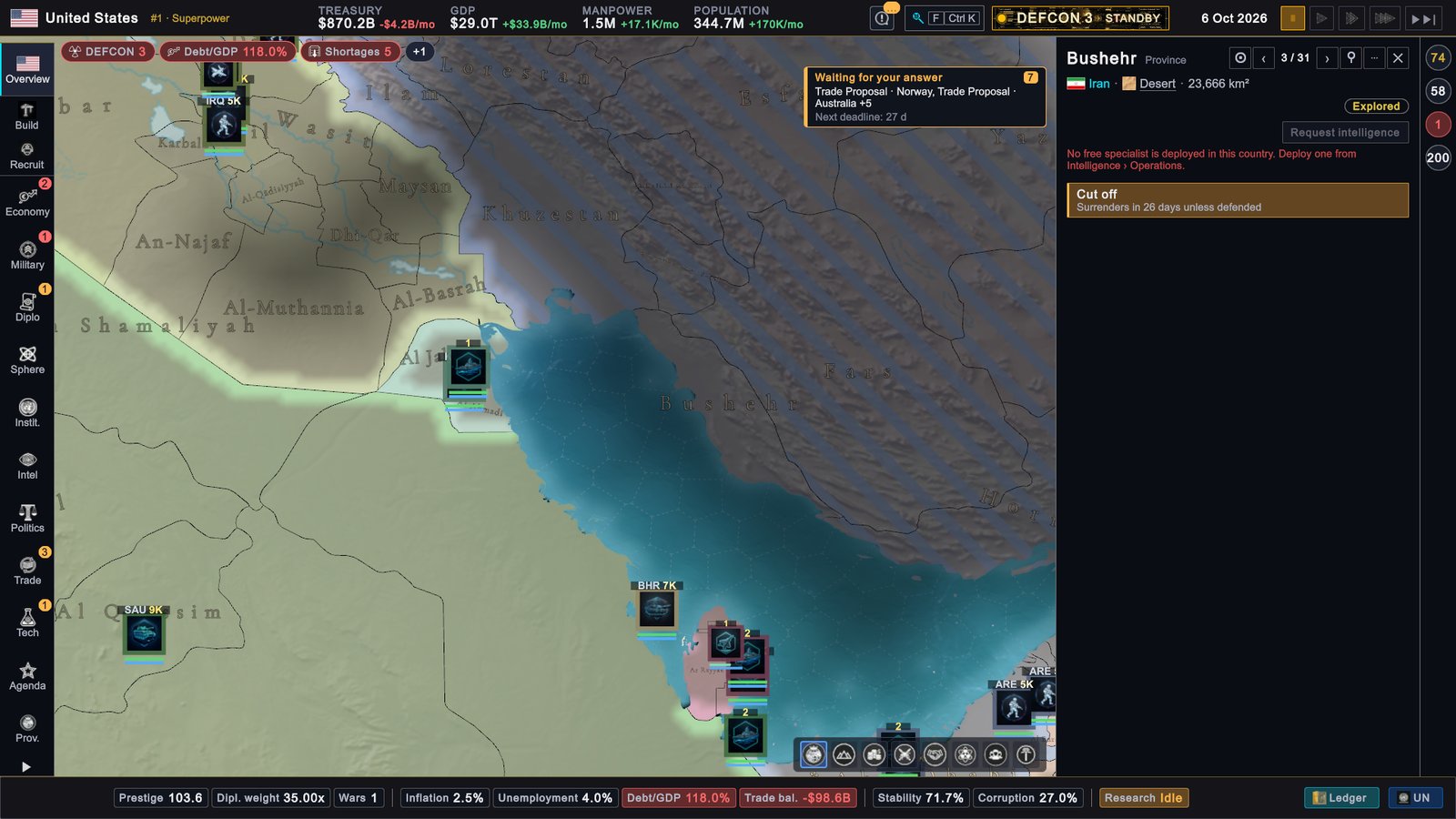
A part of a country that an occupation has cut off from the rest of its land can fall without a siege. If no army of its owner, or of the owner’s allies, stands in the cut-off part for 30 days, it surrenders to the occupier that borders it most. It becomes occupied, not owned: the peace still decides who keeps it, and its time held starts from that day.
The province page shows Cut off and Surrenders in … days unless defended. Putting an army in the pocket stops the count. The part that holds the capital, islands and exclaves never surrender this way.
Capitulation
A country gives up the fight when its enemies hold enough of its value for long enough. Value is not the count of provinces: it weighs population, economy and area, and the capital counts one and a half times. The share needed grows with the size of the country, from about half for a small one towards nine tenths for a giant. A calm government, an ally that still has armies in the field against the same enemies, and nuclear weapons that can still strike back all raise it. The share must hold at the monthly check for three months.
When a country capitulates:
- Its land armies stand down. They are disbanded and half their manpower returns to its reserve. Its fleets and air wings are not touched.
- It cannot recruit land units or order missile strikes.
- Its land is not yours yet. You still have to take what is left, by siege, by the Occupy area order or in the peace.
- It lifts if the share held falls clearly below the line, for example when its allies win land back.
The war page names the share held, the line and the months left, and a notice tells you when an enemy, an ally or a neighbour capitulates.
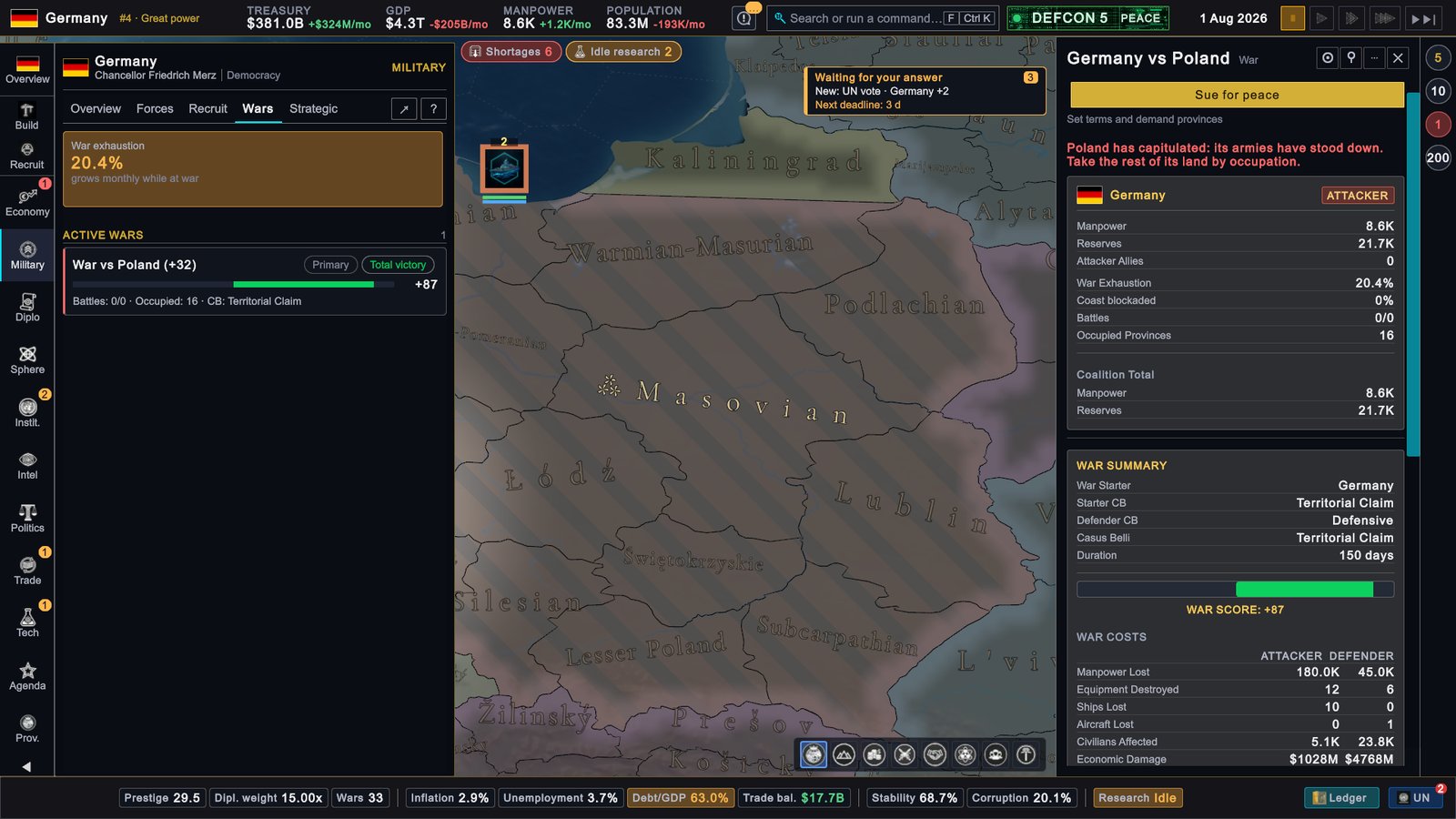
A capitulated AI country accepts a peace whose terms fit the war’s size cap. A capitulated country played by a human is never signed into a peace: its player answers every offer, and can always refuse.
Unrest, resistance and devastation
- Unrest jumps by 30 points when a province falls and keeps rising while it is occupied. Unrest lowers what a province produces.
- Resistance is a 0 to 100 figure that climbs in an occupied province, faster where unrest is high and the garrison is thin. After liberation it fades by about a point a day. A province that changes owner in a peace deal starts with resistance already raised; see Annexed land below.
- Devastation is war damage, also 0 to 100. Every day of fighting in a province adds to it, and so does bombing. It cuts the province’s production by up to 80%, damages infrastructure once it passes 10, and drives people out each month. It heals by about a point a day.
The peace view
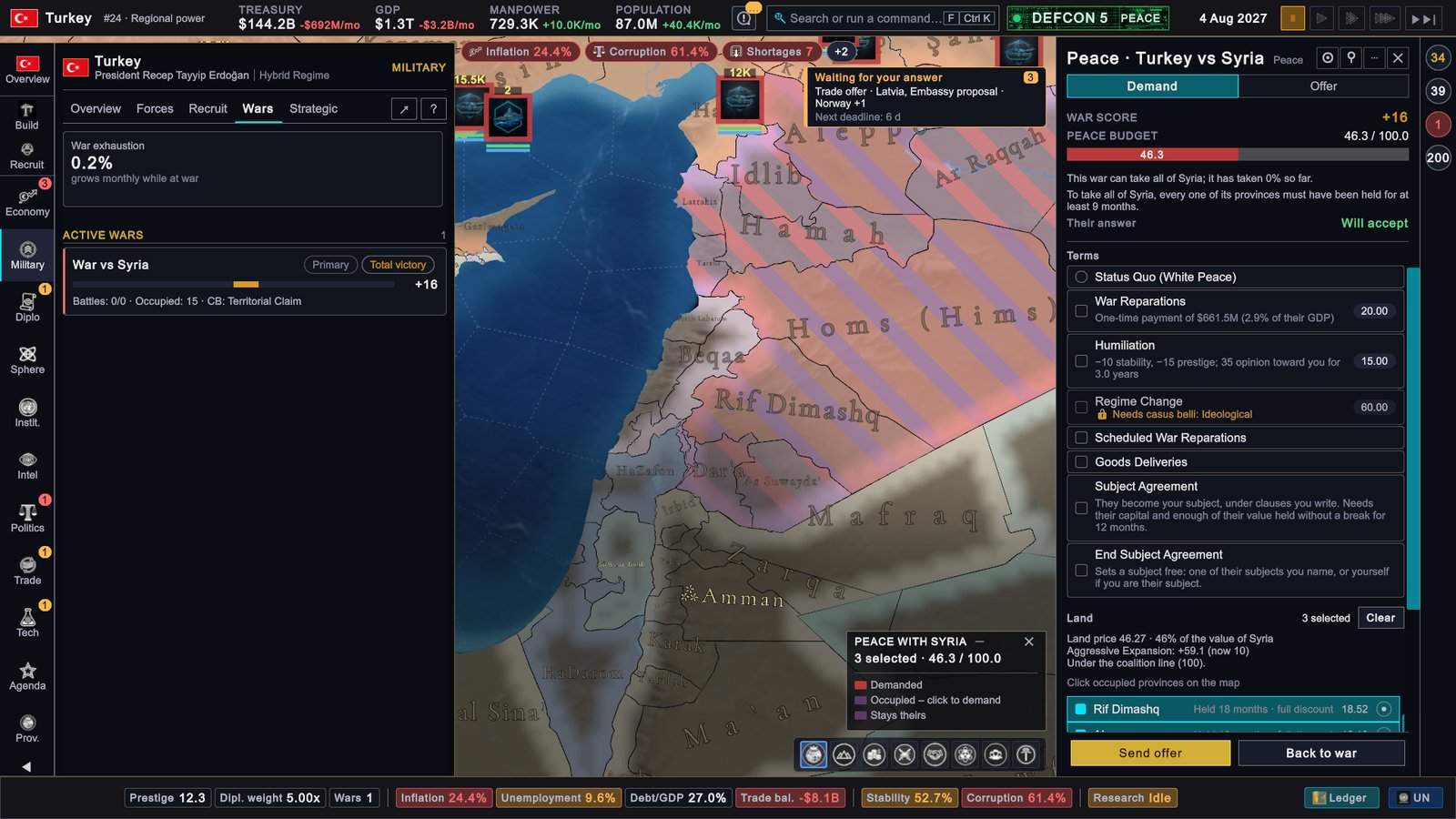
At the top of the peace view are your WAR SCORE, your PEACE BUDGET as spent out of available, two lines about the size cap, and Their answer. Below are the Terms and the Land list.
Your budget is the larger of two things: your war score, when it is positive, and the share of the enemy’s value you hold, as points out of 100. Holding the whole country gives the full 100.
| Term | Cost | Needs | Effect |
|---|---|---|---|
| Status Quo (White Peace) | 0 | Nothing | The war ends with no change |
| War Reparations | 20 | Nothing | One payment from their treasury: 3% of their GDP, limited by what they can pay. The row shows the sum |
| Humiliation | 15 | Nothing | They lose 10 stability and 15 prestige and resent you for years |
| Regime Change | 60 | Ideological reason | A ruling party aligned with you takes office; they lose 10 stability |
| Scheduled War Reparations | 15, 30 or 45 | Nothing | They pay a share of their monthly revenue for years. See Payments and deliveries |
| Goods Deliveries | 5 for each good | Nothing | They sell you goods every month at a fixed price. See Payments and deliveries |
| Subject Agreement | 25, plus 15 for each area it binds | A long, sustained hold | They become your subject. See Subject and release terms |
| End Subject Agreement | 30 | A subject agreement to end | A subject goes free. No land moves |
| Land | Set by value, see below | Territorial Claim or Reconquest, or a decisive win | Each picked province becomes yours |
White peace excludes every other term. A locked term shows what it needs.
Land without a land reason. Any side can take provinces if it holds at least one of them and its peace budget is 55 or more. Until then the Land section reads “Land can’t be demanded”.
What land costs
Every province has a share of its country’s value: population and economy count 40% each, area 20%, and the capital counts one and a half times. The price of a province, in peace budget points, is 100 times that share, divided by two things: the size cap of the war and the time held. Both are shown in the peace view.
Size cap. The bigger a country is next to the world, the smaller the share of it that one war can take. The cap is set by the country’s population, economy and area when the war reaches it. Whatever every separate peace of the same war takes counts against it, so splitting a deal does not get round it. The line under your budget says how much of the country this war can take and how much it has taken so far.
- A small country has no cap. You can take it whole, once you have held every province for long enough.
- A middle-sized country is taken in part. In the game’s own screens, one war can take about 41% of Iran or 35% of Turkey.
- A giant can lose only a few percent of its value in one war. The United States or China would take many wars.
A smaller cap also makes every province dearer, because the price is divided by it.
Time held. Freshly taken land costs about five times its full price. After one grace month the price falls every month, and you pay the full price once you have held the land for a year and a half. Each land row shows the months held and how much cheaper that makes it, with a tooltip for the share of its value and the price without the discount. The count starts again whenever a province changes hands.
Taking a whole country. A deal that takes a country’s last province needs every one of its provinces to have been held for at least nine months. Until then the peace view tells you so.
Aggressive expansion. Aggressive expansion is counted from the full value of the land, not from the discounted price, so waiting does not make a conquest look smaller to the world. Bigger countries are worse to take. Neighbours and allies of the victim take it half as hard again, and the leader of its sphere twice as hard. The Land block shows the gain, your new total and whether you stay under the coalition line, and a notice names who is most alarmed. Taking a whole country adds 25 more.
Picking provinces
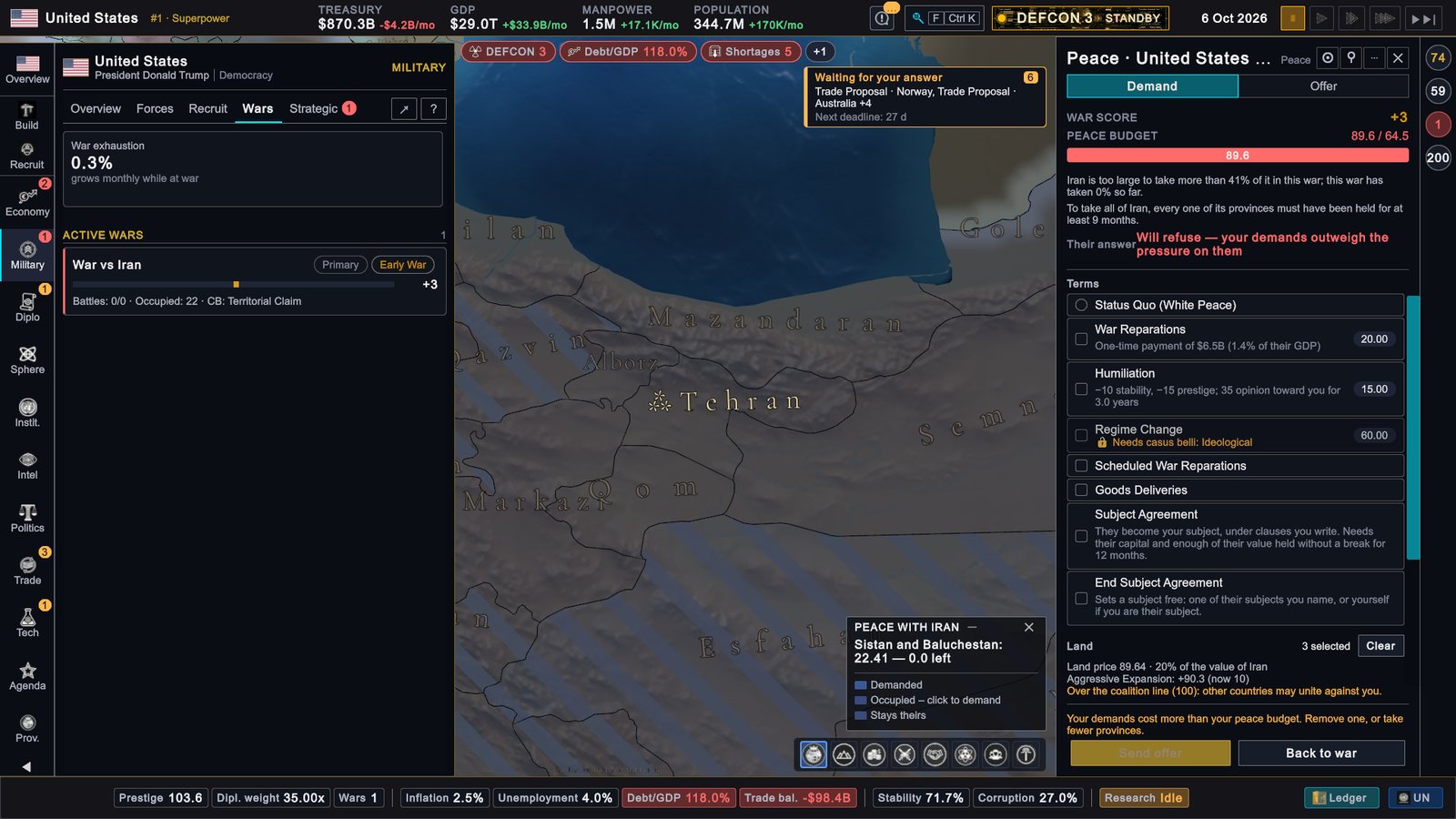
While the peace view is open the map shows three colours: Demanded, Occupied – click to demand and Stays theirs. Click an occupied province on the map, or tick it in the Land list. Only provinces you occupy can be picked. Terms that cost more than the budget, or land beyond the size cap, cannot be sent.
Payments and deliveries
Land is not the only way to collect. Two terms ask for money and goods over time, and against a large country they are often the realistic choice. An AI winner asks for them when it is the weaker side, or when the loser could still hit back with nuclear weapons.
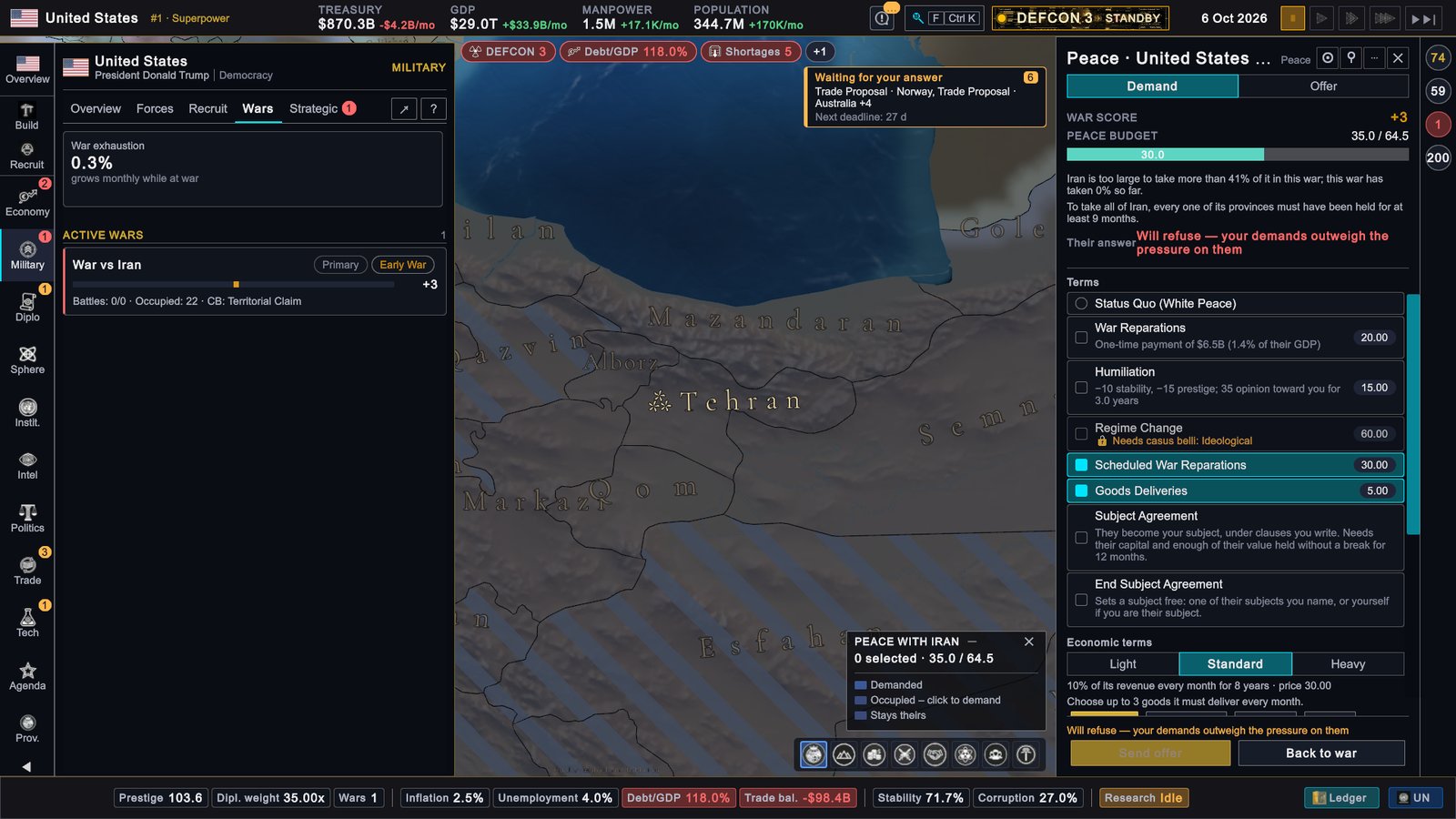
Scheduled War Reparations. Pick Light, Standard or Heavy. The loser pays a share of its monthly government revenue for a number of years:
| Size | Share of revenue | Years | Price |
|---|---|---|---|
| Light | 5% | 5 | 15 |
| Standard | 10% | 8 | 30 |
| Heavy | 15% | 10 | 45 |
Goods Deliveries. Choose up to three goods. The loser sells you a quarter of its surplus of each one every month, at a quarter of the world price, fixed for five years. It needs a surplus of each good. Each good costs 5. The delivery is a supply contract you can see in the Trade screen.
These two terms keep their price against a country with nuclear weapons.
If the payer falls behind. A payment is taken only from what the treasury holds above its protected floor. What it cannot pay becomes arrears, which carry forward, up to a year of payments. If arrears are left when the term ends, the term runs on for two more years with only the arrears due, and then the rest lapses. A new war between the two ends the schedule. Notices tell both sides when someone falls behind, signs, completes or is forgiven.
Default. Missing payments is not a default. A default is a deliberate act: the payer walks away from the terms. The truce between the two ends, the other side gets a reason for war, and the world trusts the payer less. Cancelling a goods contract in the Trade screen is a default if you are the payer, and a pardon if you are the receiver. For a payment schedule, open the other country’s Diplomacy page: its Peace payments section lists every schedule and goods delivery between you, both ways, with months left, paid so far, arrears and the next due date. The payer can Repudiate, after a confirmation that names what the default will cost. The payee can Forgive the rest: nothing more is owed, the payments stop, and nobody loses relations or trust.
Subject and release terms
A peace can make the loser your subject instead of taking land, or free a subject. Neither moves a province. Subject states explains the agreement itself.
- Subject Agreement. You write the clauses. It can be a Dominion or a Vassal, never a Comprehensive Central Authority. Your side must have held the loser’s capital and enough of its value to make it capitulate, without a break, for twelve months. The price is 25 plus 15 for each area the clauses bind, and rises for bigger countries; it doubles against a country with nuclear weapons and is up to three times as high for a country that left your control in the last ten years, but never more than holding all of its land gives (100). It adds aggressive expansion, far less than annexing the country would. The loser must not already have an overlord or subjects.
- End Subject Agreement. Costs 30. You can demand that the loser frees one of its subjects, or, if you are a subject and won, free yourself. A subject that wins a war against its overlord is released this way.
- A term this peace rules out is greyed, with its reason: Subject Agreement when the loser has an overlord or subjects of its own or you are a subject, End Subject Agreement when there is nobody to set free. The two are never ticked together.
The peace view shows the hold as Held without a break for 12 months with the share and the capital, and the status the clauses make.
Offering concessions
When you are losing, switch the peace view from Demand to Offer. You can offer land the enemy already holds of yours, reparations or humiliation, within the cap and what its war score pays for. The view previews the answer: They would accept or They would refuse, with the reason. An AI winner accepts an offer that is worth at least what it would take for itself right now. A player winner finds the offer in Diplomacy › Inbox as an Offer of concessions.
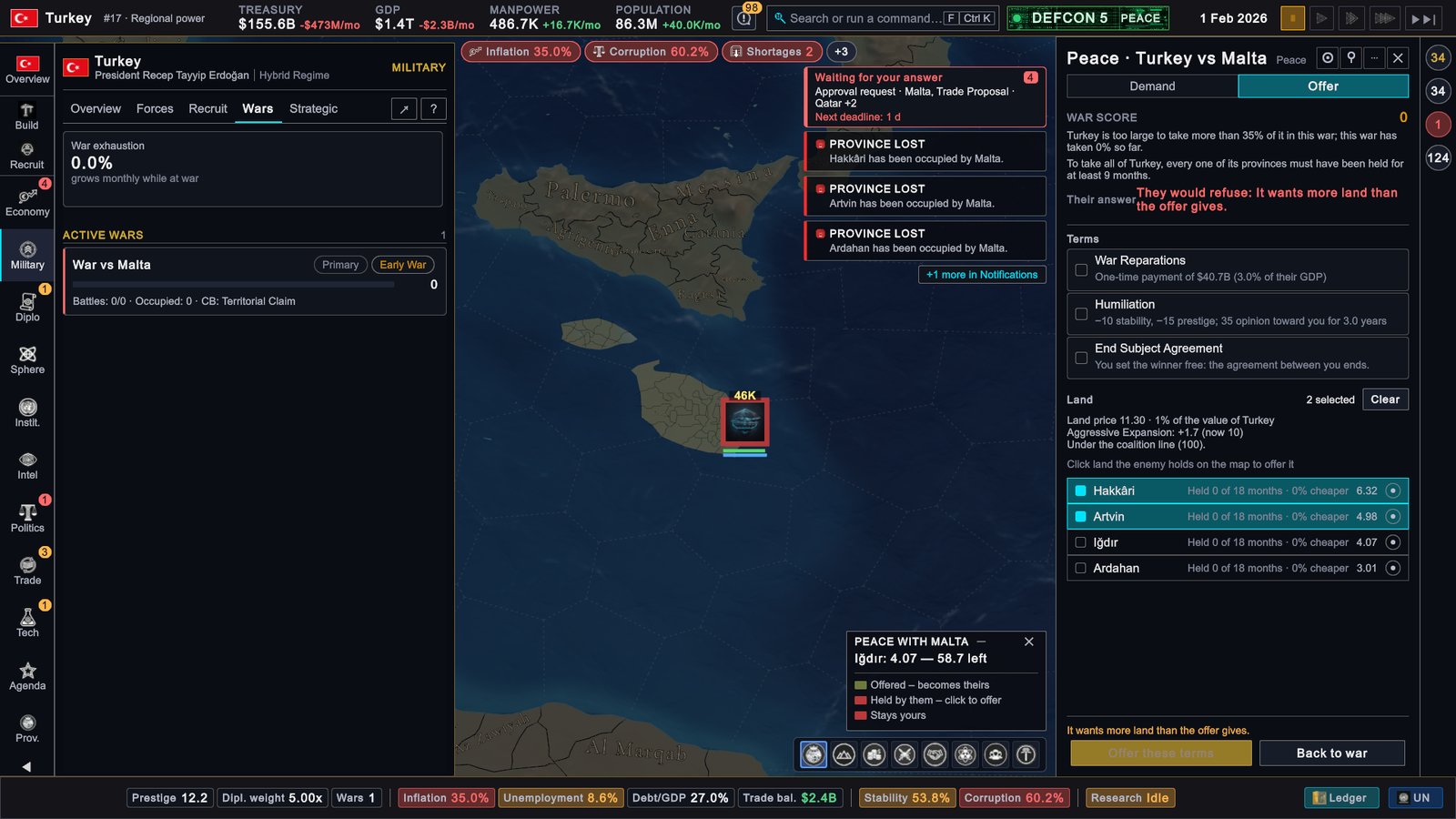
An accepted offer ends the war at once and cannot be undone.
Why they refuse
Their answer reads Will accept or “Will refuse” with a reason. An AI country decides the moment you press Send offer; if it refuses, the war goes on.
| The game says | What it means |
|---|---|
| they are winning and won’t settle for nothing | You offered a white peace while their war score against you is +25 or better |
| they took major ground and won’t accept a white peace | They have held at least two of your provinces in this war |
| their leaders want the war to go on | An aggressive or expansionist government will not take an early white peace |
| the war does not weigh on them enough to settle yet | White peace: the pressure on them is below what they need |
| your demands outweigh the pressure on them | The same, with demands attached |
| the land asked goes beyond what this war can take | The land is more than the size cap leaves |
They accept outright when they have capitulated and your terms fit the cap, when they are losing decisively, when they are worn out by the war, or when their whole side is far behind and you ask for a concession.
Otherwise the tooltip on Their answer lists what is weighed. Pressure comes from the War score balance, Their exhaustion, the Ground you hold, Their side’s deficit and War length, which starts to count after two years. Against it stand the Cost of your demands, Their intent and the Coalition balance.
An AI winner often keeps fighting until the land it wants has been held long enough to be cheap, and it asks for less land the closer it is to the coalition line. After about four years of war it settles for what it can get.
Offers you receive
A peace offer in your Inbox lists its terms before you answer: the provinces you would give up by name, the reparations either side would pay, and any payments or deliveries over time. A losing enemy may also send an Offer of concessions. When another player offers you land, the confirmation also shows the aggressive expansion that land adds to you and whether it takes you over the coalition line. Accepting ends the war at once on those terms. Rejecting continues it, and the proposer waits longer before offering again. An unanswered offer lapses after 120 days.
In multiplayer, a deal sent to another player is an offer they must accept, and it can include at most four provinces.
After the deal
- The picked provinces change owner at once. Every other occupation between the signers ends, and armies standing where they may no longer be are sent home.
- A truce of 24 months starts between the signers. You cannot declare war on each other while it runs.
- Both signers’ war exhaustion is halved, and suspended trade between them resumes.
- Land you took adds aggressive expansion in proportion to its full value. Annexing a whole country adds 25 more.
- Payments and deliveries you agreed start running, and a subject agreement comes into force.
Separate peace. If both signers are Primary in the war, the whole war ends and every partner on both sides gets the same truce. If either signer is Allied, only that country leaves and the wider war continues; the peace view warns you with a “Separate peace” note.
Annexed land
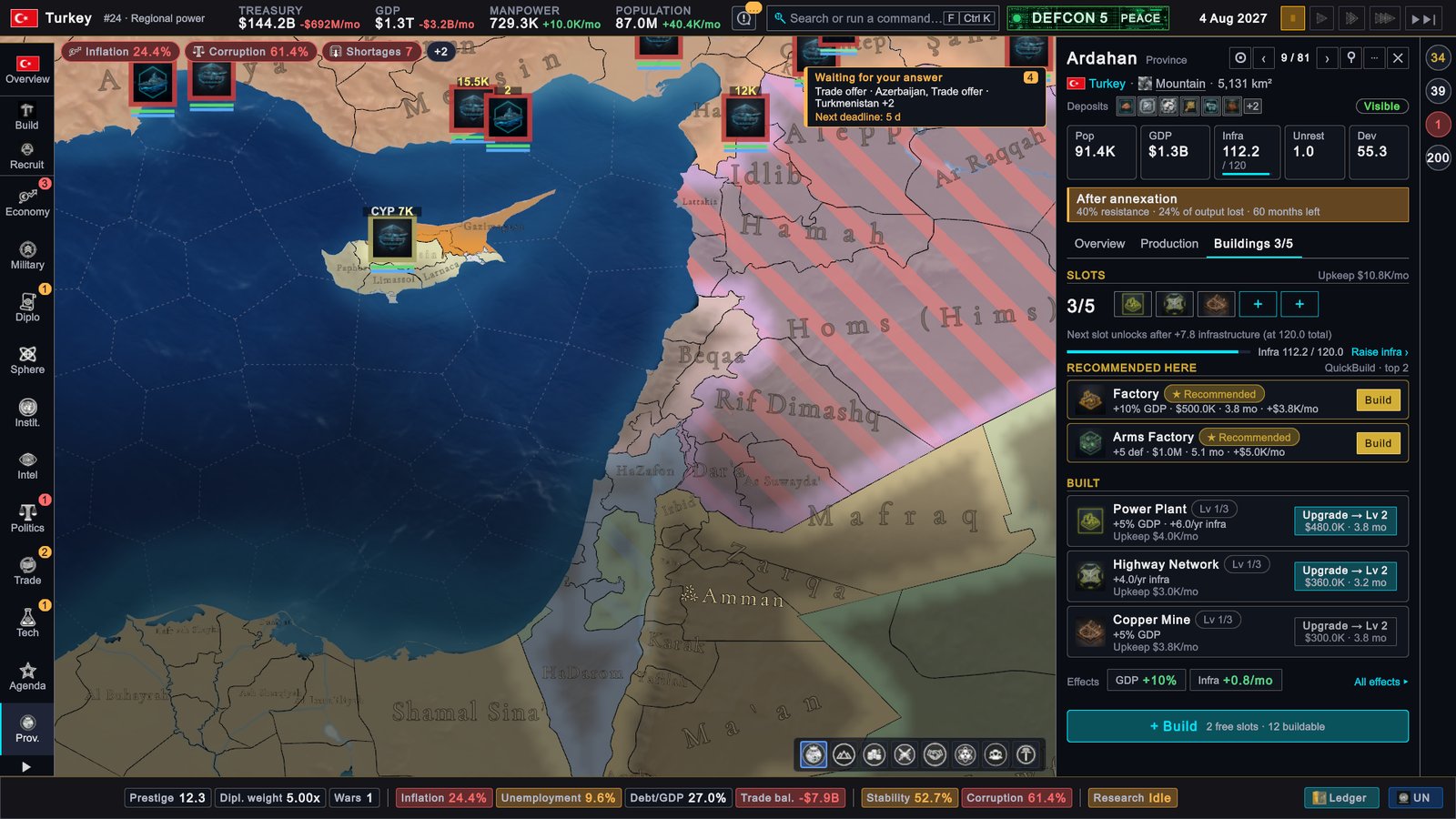
Land you take in a peace resists its new ruler. It starts with resistance, lower the longer you held it first, and the resistance fades in a straight line over five years. While it lasts, the province’s output is lower, by up to about 30% at the start, and its unrest cannot fall below half the resistance. The province page shows After annexation with the resistance, the output lost and the months left. Land freed from an occupier, rather than taken in a peace, carries none of this.
What to do
- Occupy what you want to keep. Unoccupied land cannot be demanded, however high your score.
- Read the size cap before you plan. A small country can be taken whole, a giant only in slices over several wars. For a giant, ask for payments or deliveries, or make it a subject.
- Be patient with land. Held land gets cheaper for a year and a half, and the world judges the full value either way.
- Read Their answer before you send. It updates as you change the terms.
- Break a deadlock with ground or time. Hold more of their land, or blockade their coast to raise their exhaustion.
- Garrison the provinces that matter. The owner retakes an empty province without a siege, and a cut-off part with no army surrenders in 30 days.
- Count the cost of land. Each province adds aggressive expansion, resists for years after annexation, and a devastated province produces little until it heals.
- Losing? Offer. Give up land the enemy already holds before it takes more.